
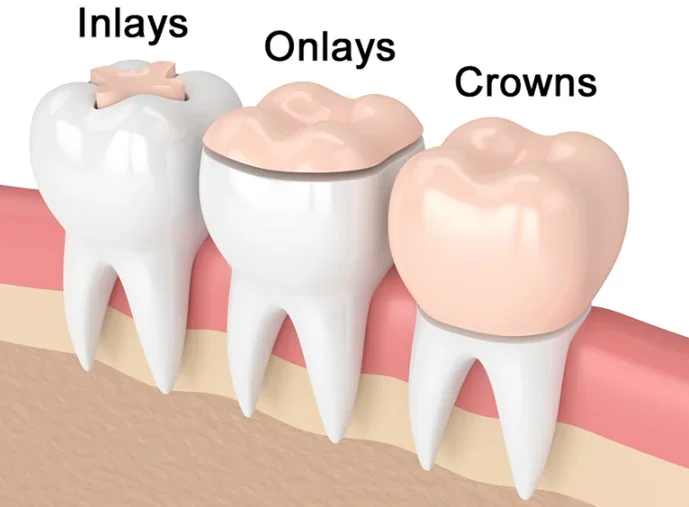
Laboratory-made or milled restorations that rebuild a tooth too damaged for a filling but sound enough to keep, without reducing it for a full crown.
Book an appointmentAn inlay or onlay rebuilds a tooth that is too broken for a filling but does not need the full coverage of a crown.
The difference matters because tooth structure is not replaceable. A crown requires reducing the tooth on every surface; an onlay keeps the walls that are still sound and replaces only what is missing. Where a tooth allows that choice, it is usually the better one.
How it is made
The damaged structure and any decay is removed, the tooth is scanned with the iTero or CEREC scanner, and the restoration is designed to fit the preparation and meet the opposing teeth correctly. It is then milled in ceramic and bonded into place.
Because it is made outside the mouth and cured fully before it is fitted, it is dimensionally more stable than a large direct filling, which is the practical reason it holds up better under load.
When it is the wrong choice
An onlay needs sound tooth structure to bond to. Where a tooth is cracked through, heavily undermined, or has already had root canal treatment and lost most of its walls, a crown is the more predictable restoration and recommending an onlay would be optimistic rather than conservative.
Ready to get started?
Laboratory-made or milled restorations that rebuild a tooth too damaged for a filling but sound enough to keep, without reducing it for a full crown.
Frequently Asked Questions
Common questions about inlays and onlays at LAL Dental.