
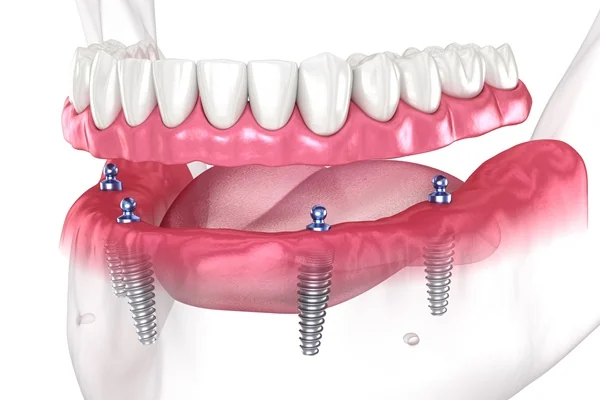
An overdenture is anchored to implants, it snaps in place and stays put. A middle option between a conventional denture and a fixed full-arch reconstruction.
Book an appointmentAn implant-supported overdenture clips onto implants placed in the jaw. It does not rest on the gum and it does not move when you eat, but it still comes out for cleaning.
Who it suits
It is most transformative in the lower jaw, where a conventional denture has the least to hold onto and where patients most often describe a denture that floats. Anchoring it to two or more implants changes what can be eaten and removes the adhesive.
- No more messy pastes or stickers that don’t hold.
- Relieves gums of pain and soreness from removable denture wear.
Fixed or removable
This is the real decision, and it is worth making deliberately:
- Removable overdenture. Fewer implants, lower cost, easier to clean because you can see what you are cleaning. Comes out at night.
- Fixed full-arch. More implants, higher cost, stays in permanently, cleaned in the mouth.
Bone volume, bite, how much lip support the denture needs to provide, and dexterity all feed into it. A cone beam CT scan and a set of records come before any recommendation, because the honest answer depends on the jaw rather than on a preference.
The planning
Dr. Lal is a Diplomate of the American Board of Prosthodontics, and full-arch work is the core of that specialty. The finished tooth position is designed first, then the implants are planned to support it, rather than placing implants and fitting a denture to wherever they ended up.
Ready to get started?
An overdenture is anchored to implants, it snaps in place and stays put. A middle option between a conventional denture and a fixed full-arch reconstruction.
Frequently Asked Questions
Common questions about implant-supported dentures at LAL Dental.